

Welcome to edition #02 of the Cercle IA newsletter. Thank you to the first 631 subscribers who put their trust in me.
This week, a lawyer with 40 years of experience asked me this question: “Do I really need to get into AI?”
The word “really” is telling. It reflects both the weariness with constant calls to innovate and a legitimate scepticism: beyond the hype, what real gain can you draw from AI with an already-established career?
I could not settle for a simple “yes.” I first answered with a question: “How long do you want to stay active?” We will meet again at the end of the summer to discuss it.
But this question stayed with me. And the answer I want to share with you is inspired by a maxim from Hillel the Elder, a great Jewish sage of the 1st century BCE:
“If I am not for myself, who will be for me? If I am only for myself, what am I? And if not now, when?”
In this edition:
- Getting started with AI: three questions applied to professional AI
- The trap to avoid: an exclusive MIT/Wharton/Harvard study revealing why letting juniors train seniors in AI can lead to failure
- The AI tool to test: an indispensable tool for avoiding AI “misinformation”
First question from the sage: “If I am not for myself, who will be for me?”
Or why no one can learn AI for you
Applied to AI, this question becomes: no one is going to adopt AI on your behalf.
Not your associate, not your assistant, not the intern “who knows computers.”
Here is a fact to take on board: AI is transforming the very nature of intellectual work. Delegating that transformation means accepting becoming a spectator of your own profession.
The three things only you can learn:
- Identify where AI excels in your field: without sufficient knowledge, you will operate with a blind spot and will not be in a position to draw the right conclusions.
- Recognise AI’s limits to avoid costly mistakes: the Harvard-BCG study shared in the first edition proves it: when you go beyond the AI’s capabilities, performance drops by 19 points.
- Develop your own usage habits: competence and intuition cannot be transmitted. They are developed through practice.
The classic mistake? Waiting for “someone else” to test, train the team, then explain it to you. In the meantime, your competitors are building up months of advantage.
Second question from the sage: “If I am only for myself, what am I?”
Or why the solo approach to AI sabotages collective performance
Individual AI adoption is necessary, but dangerously insufficient. Using ChatGPT in secret on your own? That is prioritising a temporary personal gain over the lasting performance of the organisation.
The 3 levels of AI impact
First level: your team
The real gains lie in defining and sharing best practices, creating hybrid human-AI processes, and sharing learnings AND failures.
Concrete example: a partner who masters AI can revolutionise contract drafting. But if they keep their prompts secret, the firm remains vulnerable. What happens if they leave?
Second level: your clients
Your clients are also experimenting with ChatGPT. They are wondering whether they should call on you or on AI for certain needs. The key question: “How do my AI choices truly serve my clients?”
Third level: your profession
Every professional who masters AI contributes to shaping the future of their sector. The “selfish” versus “systemic” approach: limiting yourself to the first circle means missing the transformative potential of AI.
Third question from the sage: “And if not now, when?”
Or the unforgiving arithmetic of lost time
Unlike previous technology revolutions, AI does not demand colossal investments from users. For €20/month, you access ChatGPT Plus. For €200/month, you get the most advanced tools.
The real cost? The learning time. And that time, you will never get back.
The adoption curve: we are still in the “early adopter” phase. This window is closing. Soon, mastering AI will be a prerequisite, not an advantage.
For our lawyer with 40 years of experience: in a few years, clients will compare their efficiency to that of colleagues who will have both legal expertise and AI skills. A 40-year expertise will remain an asset, but it will no longer compensate for a 40% productivity gap.
The optimal moment according to ancient wisdom: not because it is urgent, but because it is optimal. You can still learn calmly, experiment without client pressure, influence the standards of your profession, train your team gradually. In 18 months, this calm will be gone.
The real question inspired by Hillel: It is no longer “Do I really need to get into AI?” but “How am I going to integrate AI to strengthen who I already am and who I want to become?”
MIT/Wharton/Harvard study: when juniors train seniors in AI, the firm risks a learning failure
Researchers from MIT, Wharton and Harvard published a paper entitled Novice risk work: How juniors coaching seniors on emerging technologies such as generative AI can lead to learning failures.
This qualitative study was conducted with 78 junior consultants at Boston Consulting Group (BCG).
The reverse coaching paradox
The juniors had identified four major fears among their managers:
- Risk of inaccuracy: AI can produce false or “hallucinated” information
- Risk of opacity: AI is a “black box”
- Risk of decontextualisation: the solution produced can be generic
- Risk of complacency: users may blindly trust the tool
“Novice Risk Work”: the source of failure
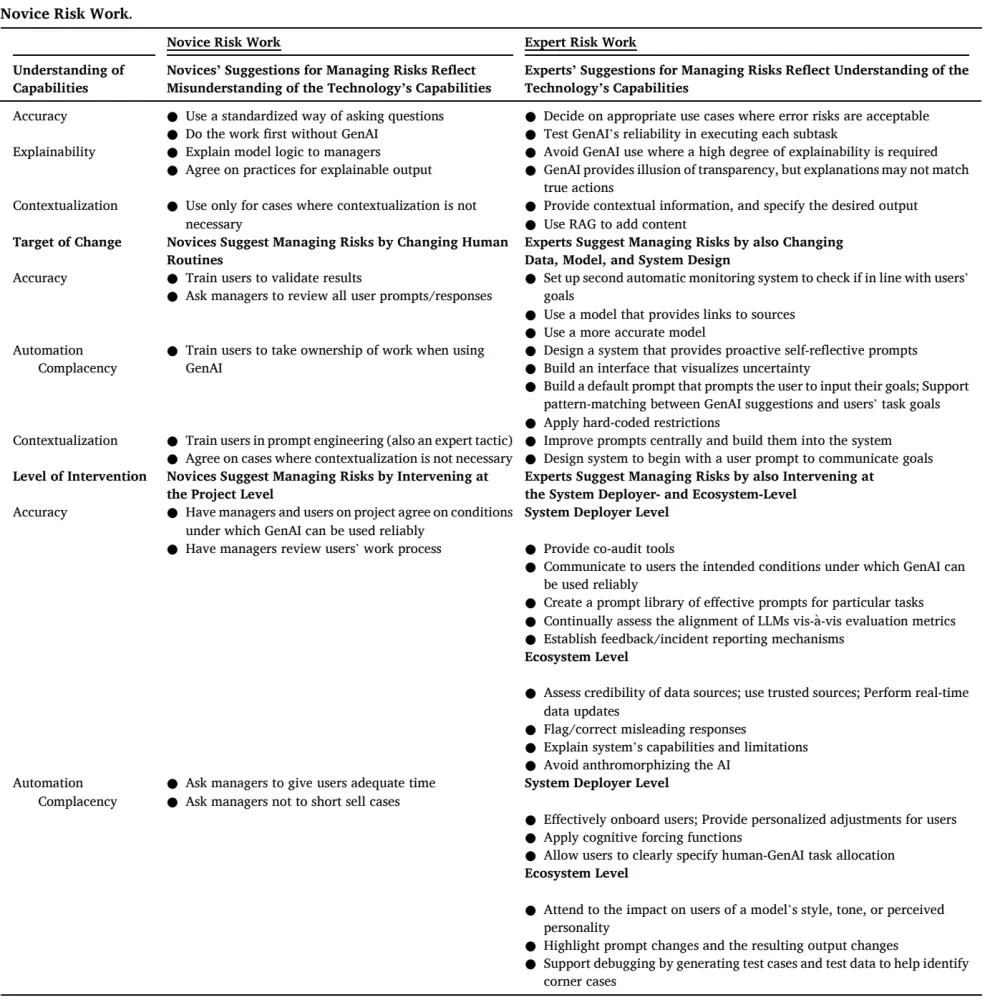
The key lesson: juniors, as AI novices, propose counterproductive solutions to manage these risks. Their solutions are well-intentioned but dangerous, because they ignore the deep nature of the technology.
Why this study matters
- Junior coaching is a trap: relying on younger staff to train an organisation in AI can lead to “learning failures.”
- Solutions need to be systemic: individual fixes are insufficient. Real risk management requires organisation-wide solutions.
- The key skill is knowing AI’s limits: more than knowing how to use AI, it is crucial to learn to identify the situations where it fails.
- AI governance is a leadership responsibility: defining a framework to manage risks cannot be delegated.
The tool to test: Perplexity

Using AI is very similar to cooking. You can have a beautiful Le Creuset casserole or the latest-generation Thermomix, but if you do not have fresh, quality ingredients, you will get nothing good out of it.
The problem with tools like ChatGPT is that it is difficult to distinguish between accurate information and that which merely appears credible. The less you know about a field, the greater the risk of using “spoiled” information.
It is to avoid this risk that I recommend everyone use Perplexity.
Increasingly popular, Perplexity combines the power of a conversational AI like ChatGPT with the reliability of a traditional search engine like Google. This hybrid tool stands out for its ability to provide fast, accurate and systematically sourced answers.
Perplexity’s key strengths:
- Intelligent search and deep exploration with automatic related questions
- Near-instant responses with systematic citations from verifiable sources
- Access to real-time information
Free vs. Pro version:
- Free version: full access to core features, web and mobile interface
- Pro version: advanced features with choice between multiple AI models (GPT-4o, Claude, Mistral…) and extended access to Deep Research features
P.S.: This newsletter may contain affiliate links to tools that I personally test and endorse. Your purchases via these links help me support this editorial work (more than a day per newsletter) at no extra cost to you.
