

#03. Why the obsession with “time saved” and automation is making you lose your bearings
“Save 10 hours a week with AI.”
It is a seductive promise. We have all heard it, dozens of times. And yet it is not only misleading, it is above all counterproductive.
Because in reality, AI is not going to save you time (right away). It asks you to invest time. To think differently. To rethink your methods, your tools, your processes.
And that is a good thing.
The professionals who truly benefit from AI are not looking to go faster. They are looking to go further.
In this edition, I want to debunk three common misconceptions that can slow your AI progress:
- Myth #1: You will gain X hours from the very first week (you always need to invest before you gain)
- Myth #2: AI will automate your repetitive tasks (spoiler: they do not exist)
- Myth #3: Faster = better (the crucial difference between efficiency and effectiveness)
- The tool to test: NotebookLM
Myth #1: “You will gain X hours from the very first week”
The hidden time equation
September 2025. A Paris consulting firm. “This AI tool saves 5 hours a week on market research.”
3 months later:
- Team training: 15 hours
- Data cleaning: 18 hours
- Error corrections: 15 hours
- Systems integration: 10 hours
- Process adjustments: 12 hours
- TOTAL INVESTED: 70 hours
To “recover” those 70 hours at 5h/week… you would need 14 “perfect” weeks. No bugs. No learning. No adaptation.
The realistic formula:
Time “saved” = Initial task time – (Learning time + Prompt time + Correction time + Monitoring time + Maintenance time)
Vendors of AI solutions and tools only show you the first term. Yet very often this equation is negative for the first 6 months. And that is normal.
The problem is not the investment. It is hiding it behind unrealistic promises.
Myth #2: “AI will automate your repetitive tasks”
Or why repetitive tasks are like unicorns
Since the arrival of ChatGPT, an obsession has taken hold: identify repetitive tasks and hand them over to AI.
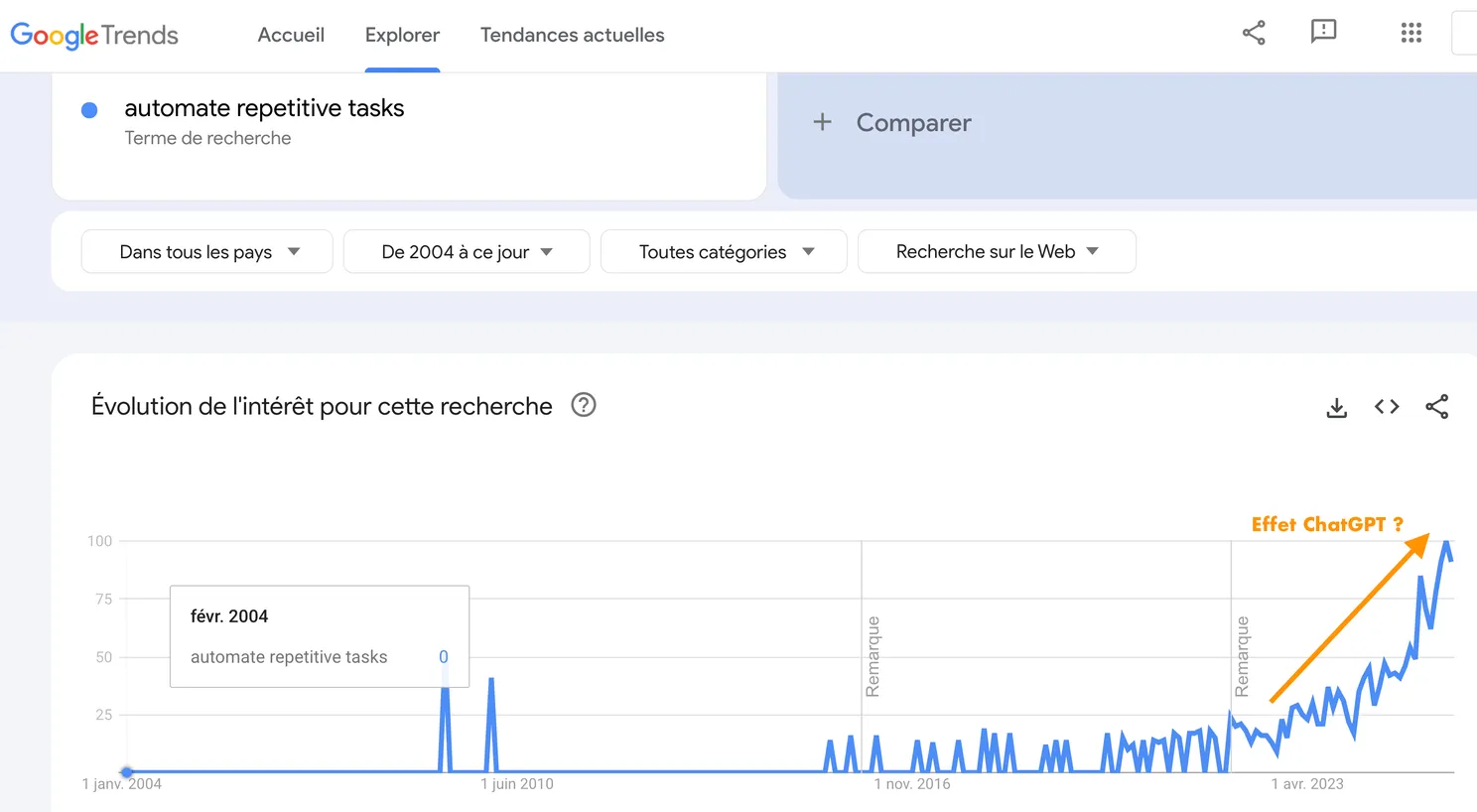
This sudden popularity of automation conceals a problem: most of these tasks are not repetitive at all.
Take an apparently mundane example: writing a follow-up email. Repetitive? On the surface, yes.
But answer this: same tone for a difficult new client and a loyal long-standing one? Same approach for €500 and €50,000? Same style for a startup and an institution?
If you answered “no” even once, your task is not repetitive. It is contextual.
The grit in the automation machine: recurring ≠ repetitive
- Recurring: a task that comes back often. You do the same action frequently.
- Repetitive: an identical task every time. You do exactly the same action, in the same context, with the same parameters.
The difference? Context. And context is 80% of intellectual work. That is precisely what AI struggles to grasp on its own, and why the human remains decisive.
Myth #3: “Faster = better”
“Speed doesn’t matter if you’re going in the wrong direction.” (Gandhi)
AI is a formidable accelerator. But just because it allows you to go fast does not mean you should lose sight of the right objective.
Effectiveness vs. efficiency: the distinction that changes everything
- Efficiency = doing things well. Focus on method, speed, resource optimisation. Question: “How do I do this task faster/cheaper?”
- Effectiveness = doing the right things. Focus on outcome, impact, relevance of action. Question: “Am I doing what it takes to reach my goal?”
Why this distinction is crucial in the AI field:
- Efficiency with AI: “ChatGPT helps me write my LinkedIn posts five times faster.” Result: 20 mediocre posts that reach no one.
- Effectiveness with AI: “AI helps me understand why my posts do not engage.” Result: 3 targeted posts that generate conversations and leads.
As management guru Peter Drucker put it: “There is nothing so useless as doing efficiently that which should not be done at all.”
3 principles to follow:
- Seek effectiveness before efficiency: ask yourself first whether the task is worth optimising.
- Invest in understanding before optimisation: learn where AI excels (and where it fails).
- Measure value created, not time “saved”: prefer 1 hour well used to 3 “optimised” hours.
NotebookLM: the AI assistant every consulting professional must urgently test
NotebookLM is a Google AI assistant that summarises, analyses and organises your documents, relying only on your sources to give more reliable answers.
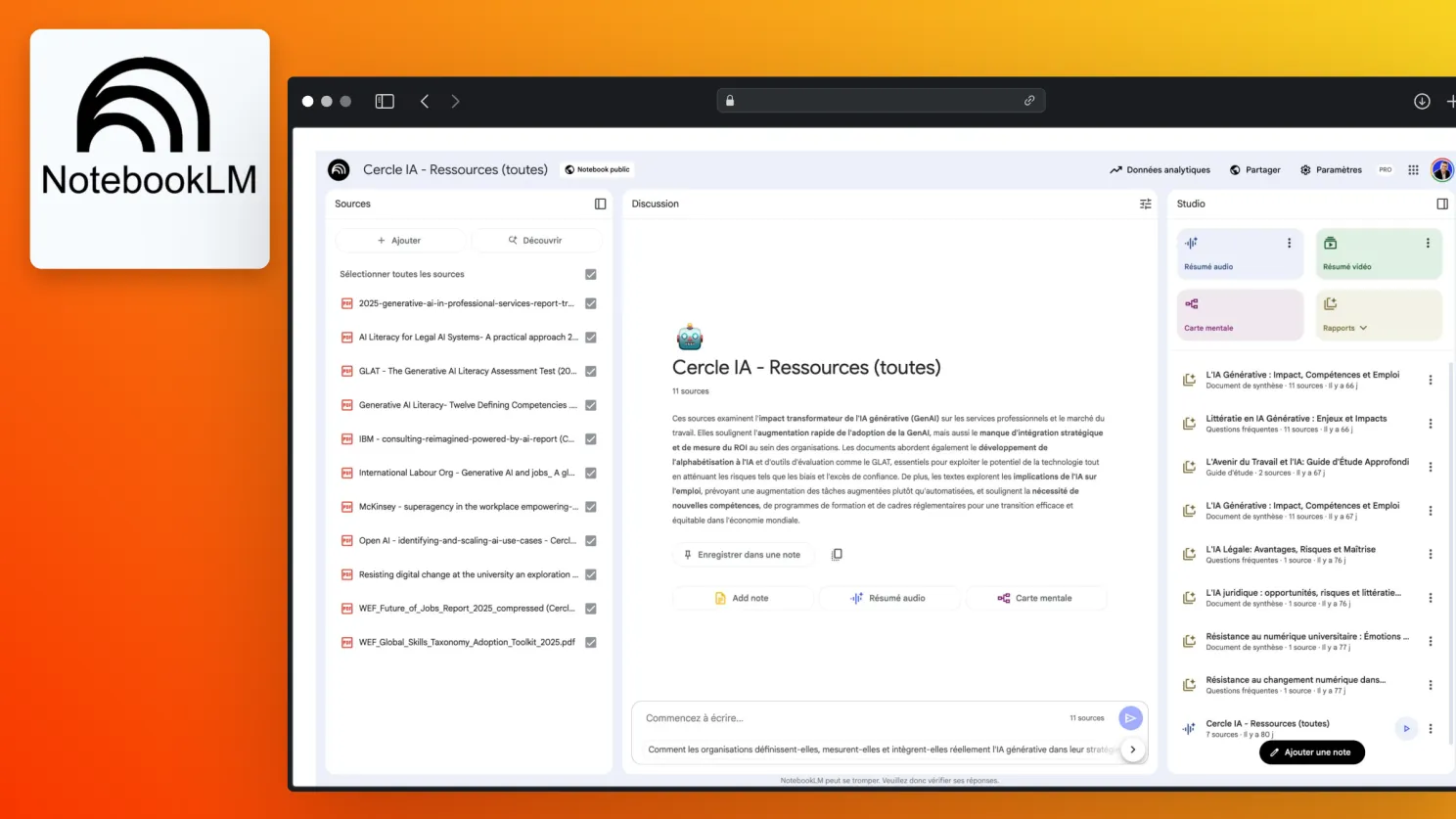
Unlike AIs such as ChatGPT, NotebookLM does not draw on all the data found on the internet, but only on the documents, notes, videos, PDFs, web links, audio files, images or Google Docs that you provide it.
NotebookLM’s main advantages:
- Multiply your sources: accepts PDFs, Google Docs, websites, YouTube videos, audio files, Google Slides. Up to 300 sources per notebook and a context of 25 million words.
- Precise citations: each response includes direct citations with links to the exact passages in your source documents.
- Privacy: uploaded documents remain private and are not used to train the model.
- Audio and Video Overviews: transform your documents into podcast-style audio discussions between two AI hosts.
- Easier collaboration: work with multiple people, share project folders with citations and annotations.
Resource: The World Ahead 2025 (The Economist & NotebookLM) is available as a Featured Notebook in NotebookLM, a first AI collaboration for The Economist. With this format, you can read the original articles, ask questions in chat and get sourced answers, explore major themes via Mind Maps, or listen to Audio Overviews.
This newsletter may contain affiliate links to tools that I personally test and endorse. Your purchases via these links help support the editorial work (more than a day per newsletter) at no extra cost to you.
