

Welcome to edition #04 of the Cercle IA newsletter. Thank you to the 90 new subscribers (you are now 805 following this newsletter).
The academic term has just started in higher education. So you can see the question coming: is generative AI finding its (rightful) place in education in Belgium?
A concerning observation: June 2025. A Belgian higher education institution consults a group of AI professionals. The finding is clear-cut: the curriculum almost completely ignores generative AI. For the students who have just started this programme — three years after the launch of ChatGPT — the shock when they enter the job market could be significant.
In this edition:
- The Belgian symptom: why fear is paralysing educational innovation
- International comparison: how our French and British neighbours are gaining the advantage
- The cost of inaction: the hidden risks of doing nothing
- The tool to test: Napkin AI, to turn your ideas into striking visuals
The Belgian symptom: when fear paralysed educational innovation
Let us start with the official document “Artificial intelligence & teaching: principles of application” published by the Fédération Wallonie-Bruxelles (FWB) in August 2025.
In this 12-page brochure, 85% of the text focuses on what to avoid doing with AI.
What you find in abundance: lists of risks, GDPR and copyright reminders, warnings about bias, alerts about technological dependency.
What you search for in vain: how to concretely integrate AI into teaching, what pedagogical methods to adopt, how to train teachers, what resources to put in place.
The result? It is like giving a highway code to a young driver without explaining how to drive.
A Belgian approach at odds with UNESCO and European Commission guidelines
The European Digital Education Hub (EDEH), launched in June 2022, has produced a robust consensus on AI integration in education with more than 7,000 members and more than 150 publications.
Three teacher competency pillars:
- Teaching FOR AI (Teaching for AI): develop fundamental civic competencies for everyone to interact with AI systems confidently, critically and safely.
- Teaching WITH AI (Teaching with AI): master the pedagogical use of AI systems and develop pedagogical judgement about when to use them.
- Teaching ABOUT AI (Teaching about AI): the more technical dimension, focused on training in AI fundamentals.
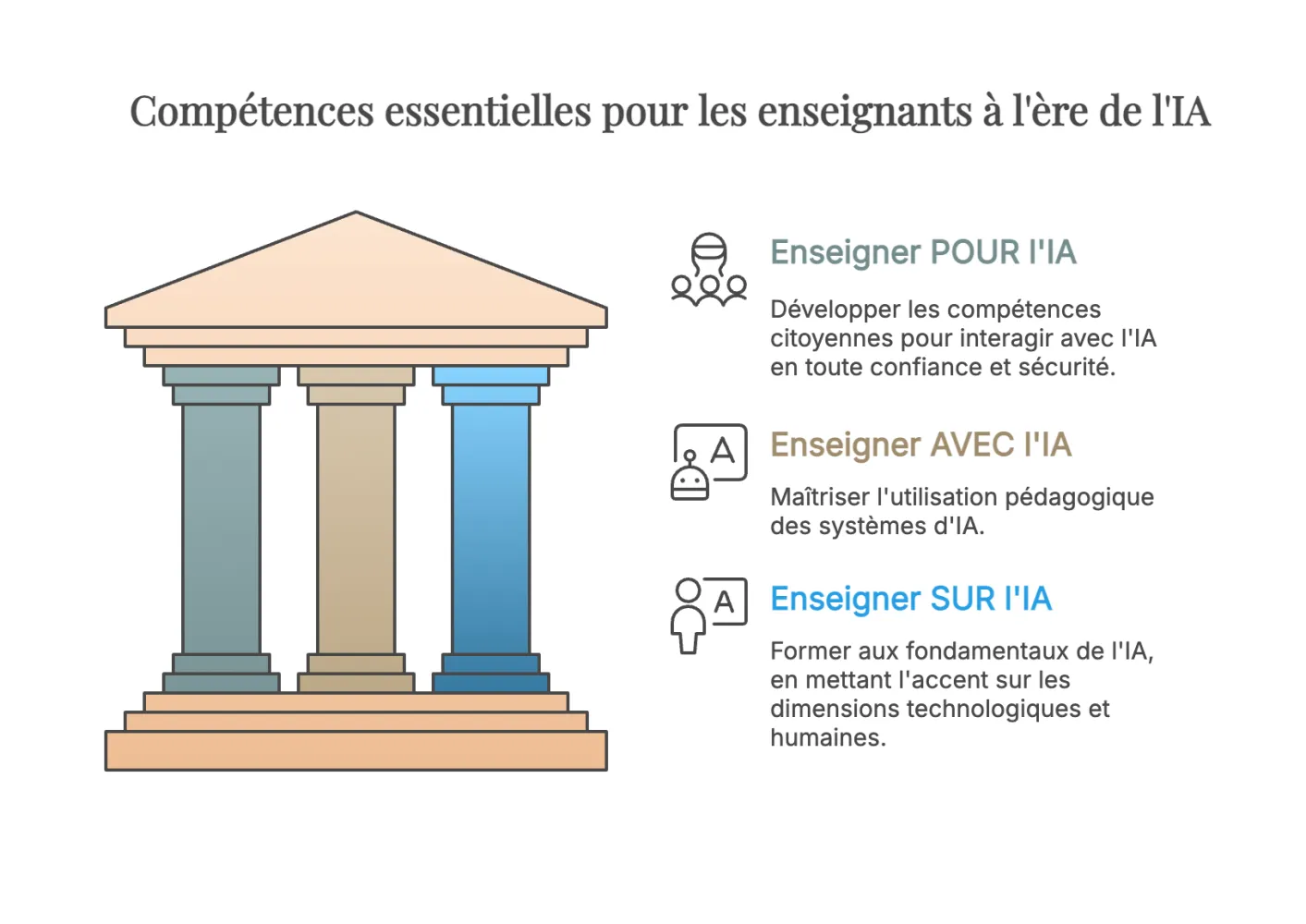
The Belgian paradox? We have access to this European expertise, documented and validated by more than 7,000 professionals, yet every institution prefers to reinvent the wheel.
Belgium, France, United Kingdom: three approaches to AI in education
Belgium (Fédération Wallonie-Bruxelles): the compliance manual
The Fédération Wallonie-Bruxelles chose the angle of maximum caution. The official document lines up rules and prohibitions: GDPR, copyright, human supervision, digital sobriety. The result: AI is perceived primarily as a threat to control rather than a pedagogical lever.
France (National Education, 2025): the official user guide
The French government published an 18-page “framework for the use of artificial intelligence (AI)” in education that presents AI’s potential before its risks. The approach is more operational than Belgium’s. In France, the use of AI in education is permitted as long as it respects the defined framework: mandatory training for students, supervised experimentation by teachers.
United Kingdom: a framework for seizing opportunities
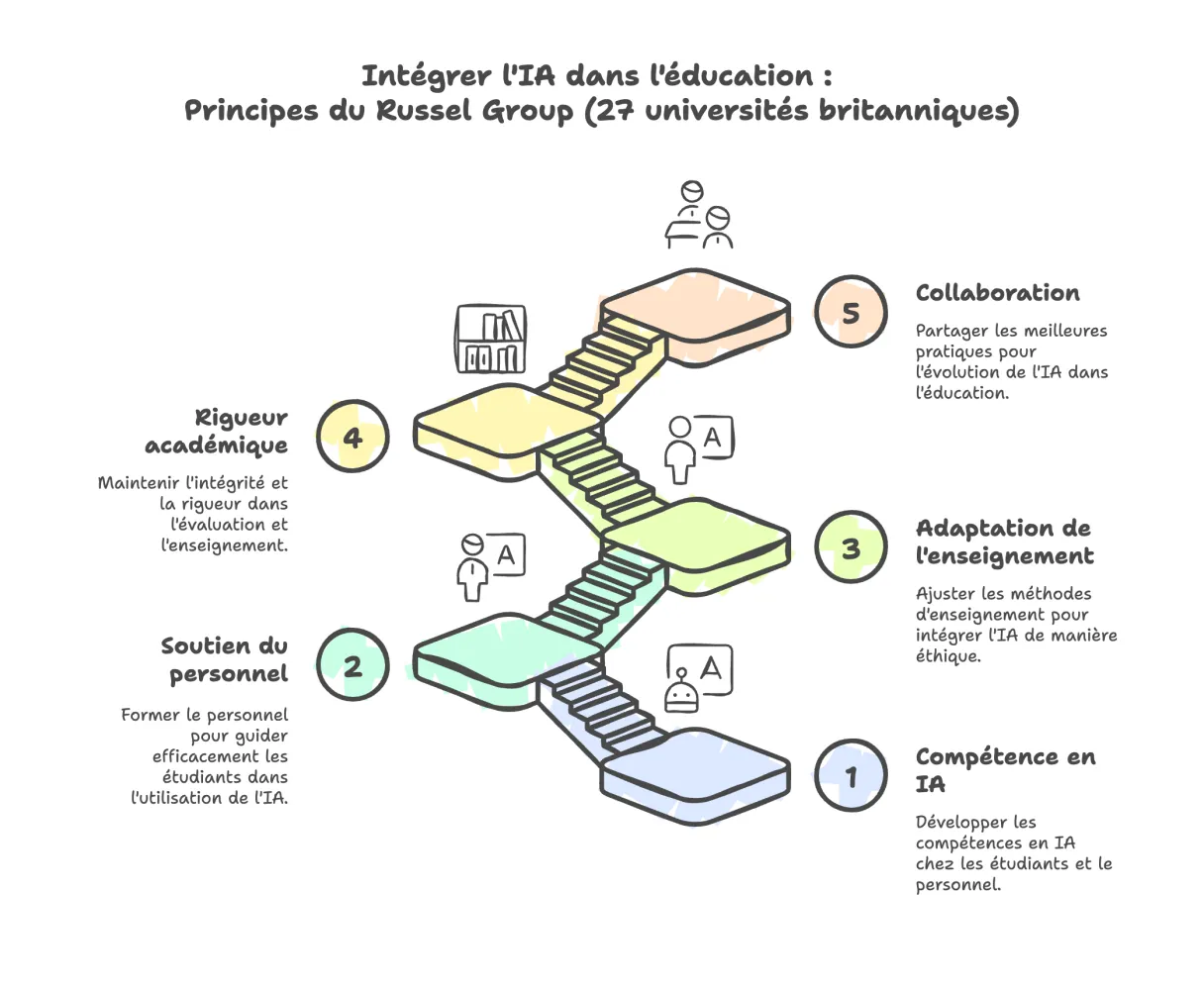
The Russell Group, the association bringing together the 24 leading British research universities (Oxford, Cambridge, Imperial College…), published a common framework for the use of generative AI in just 3 pages and five pillars in 2023:
- Universities will help students and staff become AI-literate
- Staff must be able to support students in using generative AI tools
- Universities will adapt teaching and assessment to incorporate the ethical use of generative AI
- Universities will ensure academic rigour and integrity are maintained
- Universities will collaborate to share best practice
Three visions, three speeds:
- Belgium is braking (“Don’t make mistakes with AI”)
- France is moving forward with the handbrake on (“Use AI, but under strict conditions”)
- The United Kingdom is accelerating (“Innovate, experiment, share”)
The risks of inaction
Doing nothing is not neutral. It is a choice that carries consequences:
- Sacrificing our students’ chances: in three years, they will face a job market reshaped by AI with yesterday’s skills.
- Leaving teachers without resources: without a structural framework, they are reduced to cobbling together individual solutions.
- Widening our competitive gap: while we debate, our neighbours are training the talent of tomorrow.
- The siloed technical training trap: creating a standalone AI course, taught by the IT department, disconnected from professional applications.
A message to Belgian decision-makers — three urgent actions:
- Break free from the compliance mindset. Move from “how to avoid risks” to “how to seize opportunities.”
- Draw on international consensus. UNESCO and the European Commission have done the work. Use it.
- Train at scale. Teachers first, students after. Without quality training, all fine principles remain dead letters.
Tool of the week: Napkin AI
“A good sketch is worth more than a long speech” (Napoleon Bonaparte)
Napkin AI turns this frustration into an opportunity. The tool automatically analyses your texts and instantly generates clear visuals that make your message immediately understandable.
The process is disarmingly simple: you paste your text, Napkin automatically understands the structure of your ideas, and in a few seconds generates diagrams, infographics or mind maps adapted to your content.
Why you should test Napkin AI:
- Generates a striking visual from your texts in a few seconds
- Professional design without graphic skills
- Perfect for presentations, reports and social media visuals
Three years after ChatGPT, we have a choice:
Option 1: Continue debating risks and waiting while others train the talent of tomorrow.
Option 2: Take the lead, individually and collectively.
See you soon, and do not forget to put your knowledge into practice.
