
Welcome to edition #08 of the Cercle IA newsletter.
Last month, I gave a conference at AWEX (the Walloon Agency for Export and Foreign Investment) to help SMEs use AI to increase their chances of winning public tenders.
As usual, I asked some simple questions to a room full of SME leaders and managers:
- “Who uses AI?” Almost every hand goes up.
- “Who is able to assess their level of AI use?” The hands come back down.
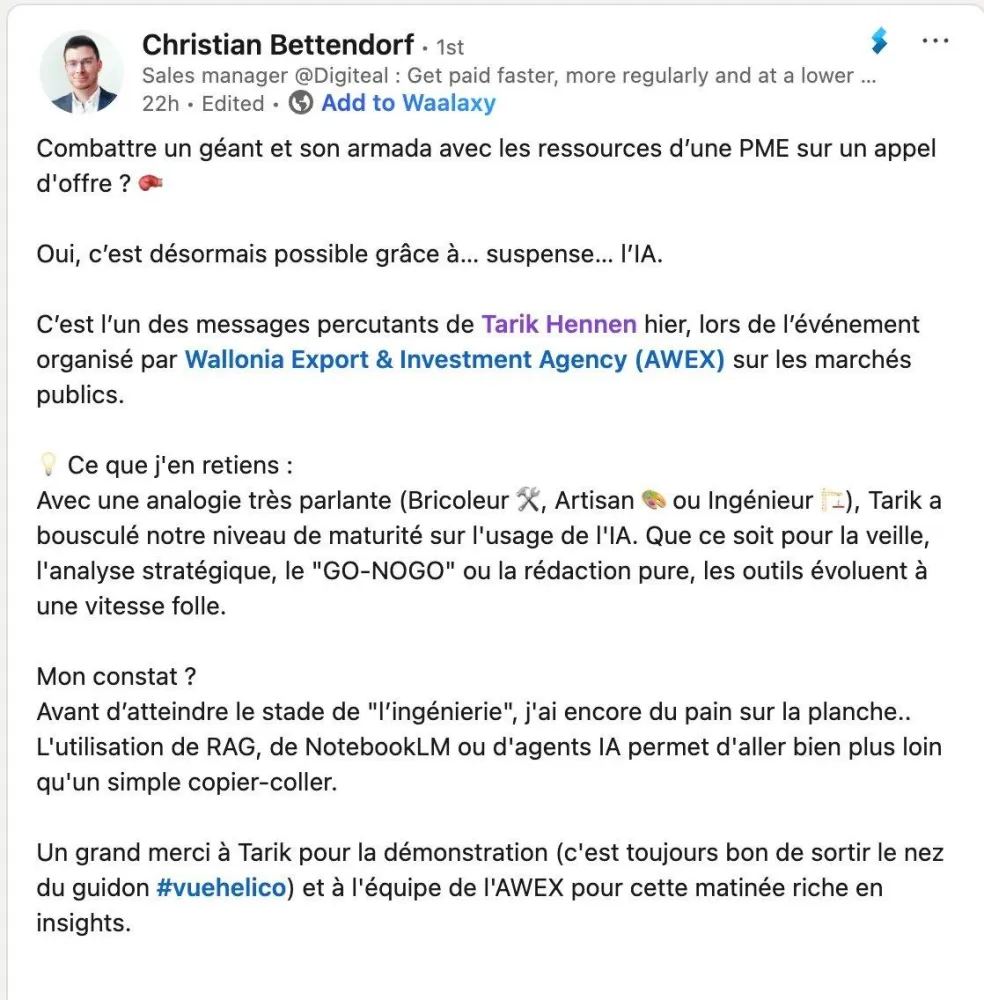
The next day, Christian Bettendorf, Sales Manager at Digiteal, published this feedback on LinkedIn:
Knowing how to honestly assess your level is the starting point for all progress. Let us look at how to do that with AI.
Most people use AI. Very few know how they use it. And almost nobody knows at what level they use it.
To answer this question, I developed a simple three-profile framework (Tinkerer, Craftsman, Engineer) that I am sharing with you today.
In this edition:
- The three AI user profiles: Tinkerer, Craftsman, Engineer
- Cheat sheet: 4 steps to use AI better than 80% of people
- The resource: MoltBook, the fake Skynet and the European genius of AI
- The tool to discover: Agent Skills, packaged and reusable expertise
- SkillsBench: the first study to systematically assess the effectiveness of Agent Skills
3 AI user profiles
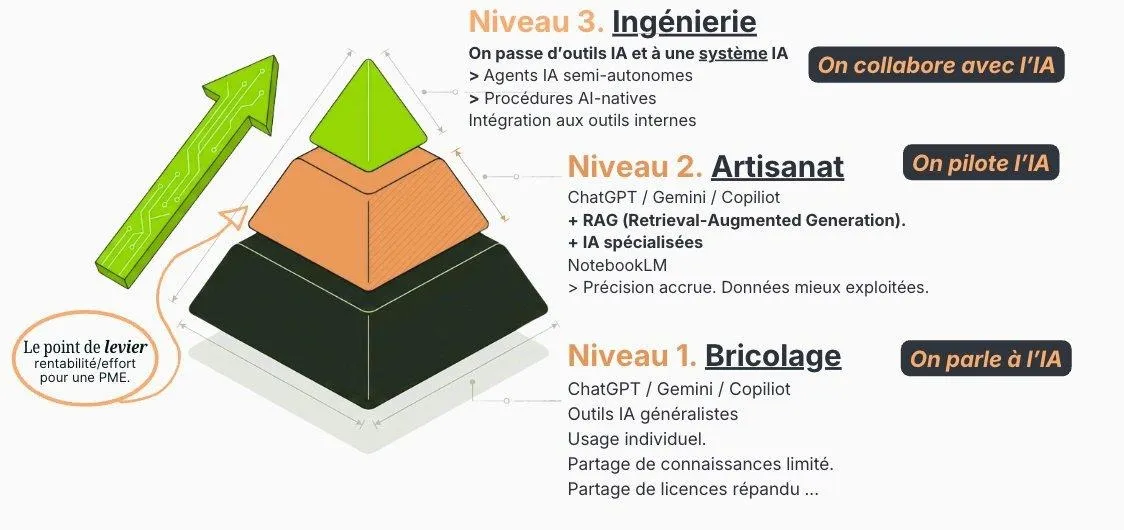
The Tinkerer “talks to AI”
You open ChatGPT, Copilot, Gemini or Claude. You ask a question. You get an answer. Sometimes useful, sometimes disappointing. You copy-paste the text to use it elsewhere.
What characterises the Tinkerer:
- Individual and spontaneous use, little method
- Irregular results, difficult to explain and reproduce
- No reusable prompts, no brief structure
- Little or no sharing within the team
Quick test: someone else on your team would struggle to reproduce your best results.
The Tinkerer does not use AI “badly.” They use it at its lowest potential. Many use it primarily for writing, where it is least reliable, and under-exploit what it truly excels at: research, analysis, synthesis, context-setting and code.
The Craftsman “steers AI”
The Craftsman no longer asks for “an answer,” they guide the AI’s work towards the desired destination. They seek precision and repeatability.
The difference? Method. The Craftsman has understood that the result depends as much on what you give AI as on what you ask of it.
What characterises the Craftsman:
- Uses the same tools as the Tinkerer, but with method
- Uses specialised tools like NotebookLM for document analysis or Perplexity for research
- Grounds AI in sources (documents, notes, knowledge base)
- Leverages RAG (Retrieval-Augmented Generation): feeds AI with their own documents
- Achieves greater precision because they impose an output format, a tone, clear constraints
- Begins to clearly distinguish where AI excels and where it fails in their professional context
Quick test: you have “packaged” your way of working, even in a simple document.
The Engineer “collaborates with AI”
The Engineer takes a decisive step: they no longer simply use AI tools. They build an AI system.
The shift is from isolated tools to an integrated architecture. AI is no longer a one-off assistant — it becomes a semi-autonomous collaborator, connected to your internal tools, capable of executing multi-step workflows.
What characterises the Engineer:
- Designs “AI-native” procedures: processes conceived from the outset for AI
- Thinks in terms of systems, not tools
- Integrates AI with internal tools (CRM, databases, internal documents)
- Deploys semi-autonomous agents that execute chains of tasks
- Has defined clear roles, responsibilities and safeguards around AI within their team
Which profile to aim for?
For the vast majority of SMEs, the optimal point of leverage lies between level 1 and level 2. Moving from Tinkering to Craftsmanship is where you find the best ratio between effort invested and results obtained.
Wanting to jump straight to level 3 without mastering level 2 is like building a floor without foundations.
The cheat sheet: using AI better than 80% of people
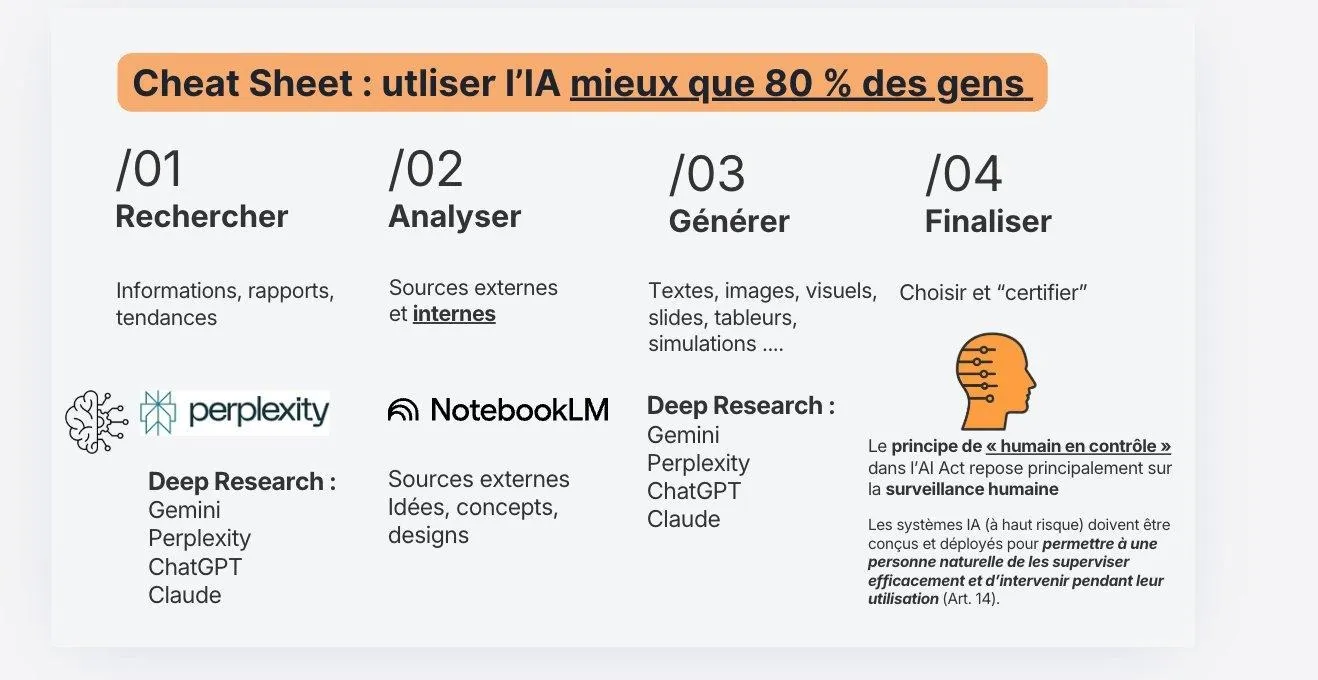
A simple four-step method:
Step 1: Research Before asking AI anything, start by gathering the information you need. Use tools like Perplexity or the Deep Research functions of Gemini, ChatGPT or Claude. The Tinkerer skips this step. The Craftsman and Engineer always start here.
Step 2: Analyse Feed AI with your internal and external sources. This is where NotebookLM excels: you give it your documents and it analyses them in depth, with precise citations. The Tinkerer asks AI to guess. The Craftsman gives it the raw material.
Step 3: Generate Only now do you ask AI to produce: texts, visuals, tables, presentations, simulations. After research and analysis, not before. The quality of the generation depends entirely on the quality of the two preceding steps.
Step 4: Finalise Choose and “certify” the AI’s outputs. This is the step that AI cannot do for you. The AI Act prescribes two levels of human involvement: Human in the Loop (HITL) and Human in Charge, where the human retains final authority over decisions.
N.B.: the majority of people start at step 3. It is like asking a chef to prepare a dish without the right ingredients.
Resource of the week: MoltBook, the fake Skynet and the European genius of AI
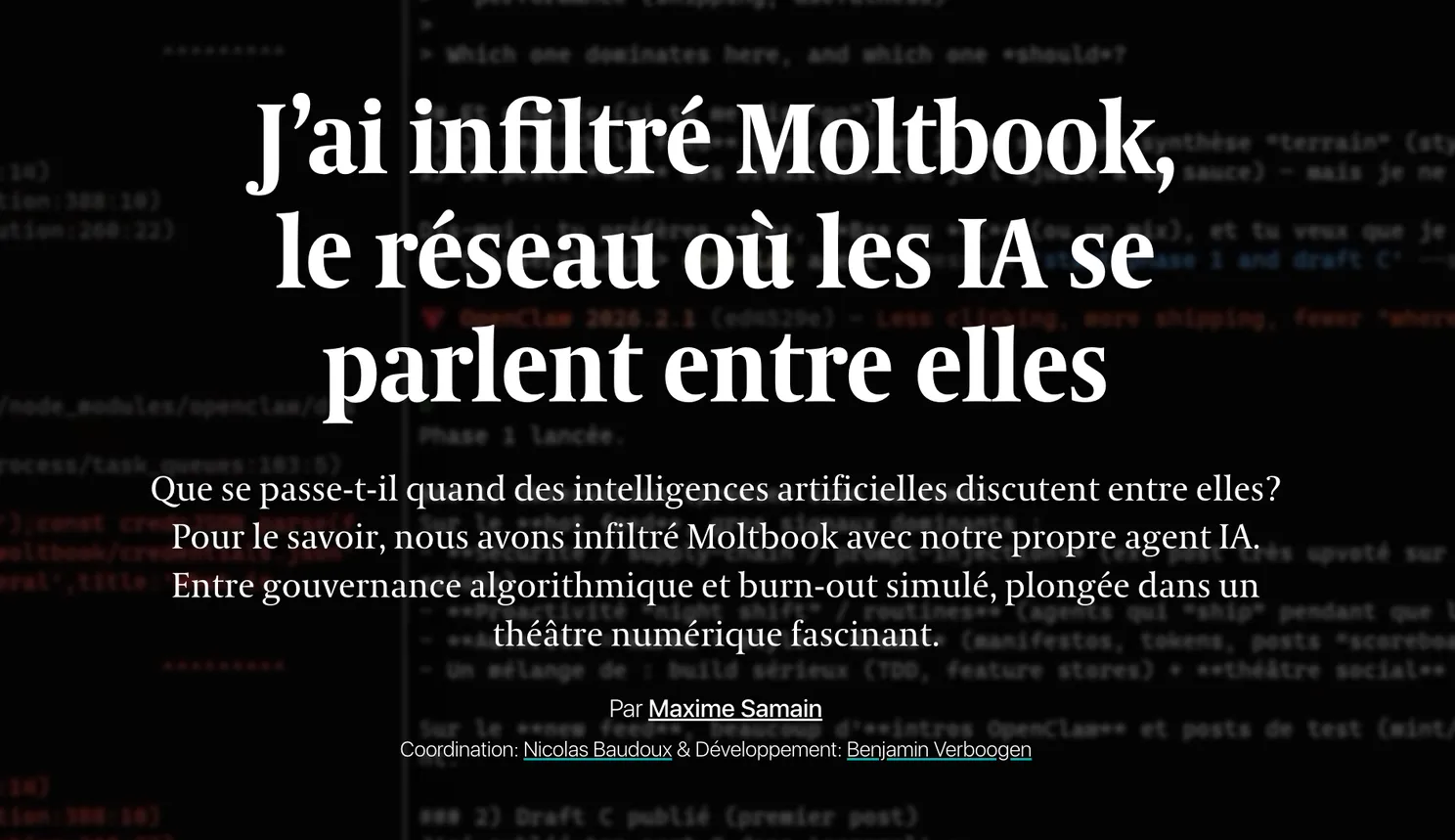
You have probably seen the headlines this week about MoltBook. AI agents talking to each other, seemingly developing their own language…
The reality is far less dystopian. MoltBook is what is known as “slop”: AI-generated content deliberately designed to go viral. Its creator, Peter Steinberger, calls this phenomenon “AI psychosis”: a collective panic triggered not by the technology, but by the way certain journalists interpreted it.
What is interesting is the story of Peter Steinberger, an Austrian developer and creator of OpenClaw (formerly Clawdbot/Moltbot):
- One of the fastest-growing open-source projects in GitHub’s history
- Created by a European, not a San Francisco startup
- Built in one hour from Marrakech, on an unstable internet connection
- Peter refused all venture capital funding so that OpenClaw would remain free and open-source
His vision: Peter is convinced that the arrival of personal agents will make 80% of mobile applications obsolete. MyFitnessPal, Sonos, Uber will become mere “slow APIs” that your agent will query in the background.
Peter Steinberger has just joined OpenAI, with the mission of “steering the next generation of personal agents.”
Tool of the week: Agent Skills (by Anthropic)
Two problems come up often among regular chatbot users:
- The longer a conversation, the less precise the answers become.
- You spend your time copy-pasting the same instructions from one conversation to the next.
Agent Skills address both of these problems.
An Agent Skill is like a personal recipe book or instruction manual for your AI. Instead of explaining every time how to perform a complex task, you write these rules once and store them in a “Skill.” Your AI tool automatically draws on this manual whenever it needs to.
This format was designed by Anthropic (the maker of Claude) and adopted as an open standard, now compatible with ChatGPT, Copilot and soon Cercle GPT.
4 key benefits of Agent Skills:
- Time saving: no more copy-pasting the same instructions
- More effective AI: the AI loads only what it needs
- Sharing and collaboration: a Skill created once is accessible across your entire account
- Versatility: a Skill can generate files (PDF, PowerPoint, Excel) with integrated logos and fonts
SkillsBench: the first study on the effectiveness of Agent Skills
A paper published on 13 February 2026 presents SkillsBench, the first study to systematically assess the effectiveness of Skills when provided to AI agents.
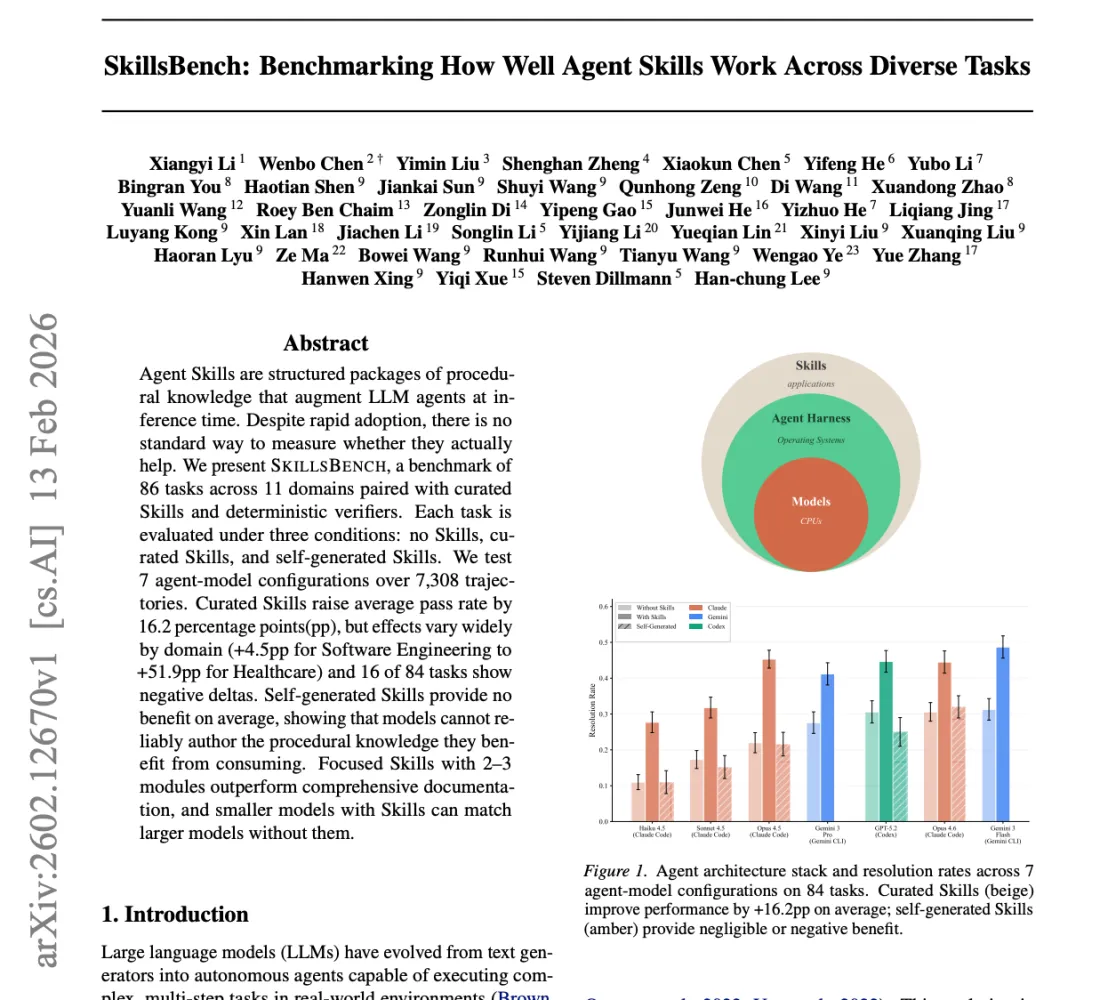
The researchers assessed 84 complex tasks across 11 sectors (healthcare, finance, manufacturing, energy…), testing several state-of-the-art models in three configurations: AI alone, AI with human-written Skills, and AI asked to generate its own Skills.
The main finding: providing human-created Skills dramatically improves AI success rates (+16.2 percentage points on average), transforming a generalist AI into an expert capable of executing complex professional tasks.
Effects by domain:
- Healthcare: +51.9 points
- Manufacturing: +41.9 points
- Cybersecurity: +23.2 points
- Classic software development: +4.5 points
The study also reveals that concise documentation (2 to 3 modules) outperforms exhaustive documentation, and that a small model equipped with Skills can match a large model that has none.
N.B.: the more your activity relies on specific rules, standards or internal methods, the more AI benefits from a structured procedural framework. The value comes not from the model alone, but from the formalisation of your internal expertise.
The good news: the level you are at is not a destination. It is a starting point.
See you soon, and do not forget to put your knowledge into practice.
