
Reread the last text you wrote with the help of AI.
A LinkedIn post. A client email. A memo to your team.
And ask yourself this question: do you recognise your own way of formulating an idea? Or are you reading someone else writing in your place?
If you hesitate, this edition is for you.
AI does not just betray you to your readers. It betrays you to yourself, sometimes to the point where you no longer know what you would have said without it.
Beyond the words that give AI away: pre-formatted thinking
You already know them.
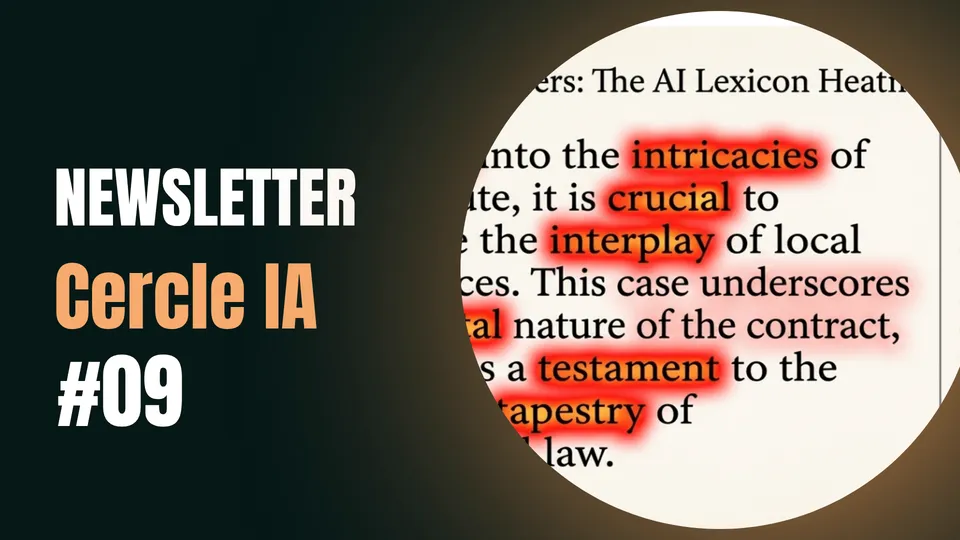
“In a world where AI is transforming our professions…” Long dashes appearing in the middle of every sentence. Stacked adjectives: crucial, pivotal, unmissable. Conclusions that summarise what was just said. Three-point lists. Always three.
With a little AI practice, you spot these signs in two seconds, you learn to delete them, and you tell yourself you have done the work.
But here is the problem: you stop there.
And by stopping there, you confuse the symptom with the disease.
In August 2025, the editors of Wikipedia published a catalogue of more than 40 ways to spot AI writing, drawn from the analysis of thousands of LLM-generated contributions since 2023. They called it Signs of AI Writing.
This resource goes well beyond the list of words to avoid. It lays bare the typical way AI thinks about text.
Simulating nuance without having any. Producing the appearance of reasoning without following its thread. Filling space with form to mask the absence of substance.
The caricatural words of AI are only the visible surface. Underneath, there are reflexes that are far more difficult to detect. And far more difficult to correct.
The 5 digital fingerprints of AI in your writing
Wikipedia has highlighted construction habits that AI models reproduce systematically, regardless of language, regardless of version.
Here are five signs that betray the use of AI. In isolation, each can go unnoticed. Together, they stand out like a signature.
1. Negative parallelisms, or false nuance
AI loves oppositions. “It is not a question of technology, it is a question of culture.” “It is not a tool, it is a paradigm shift.”
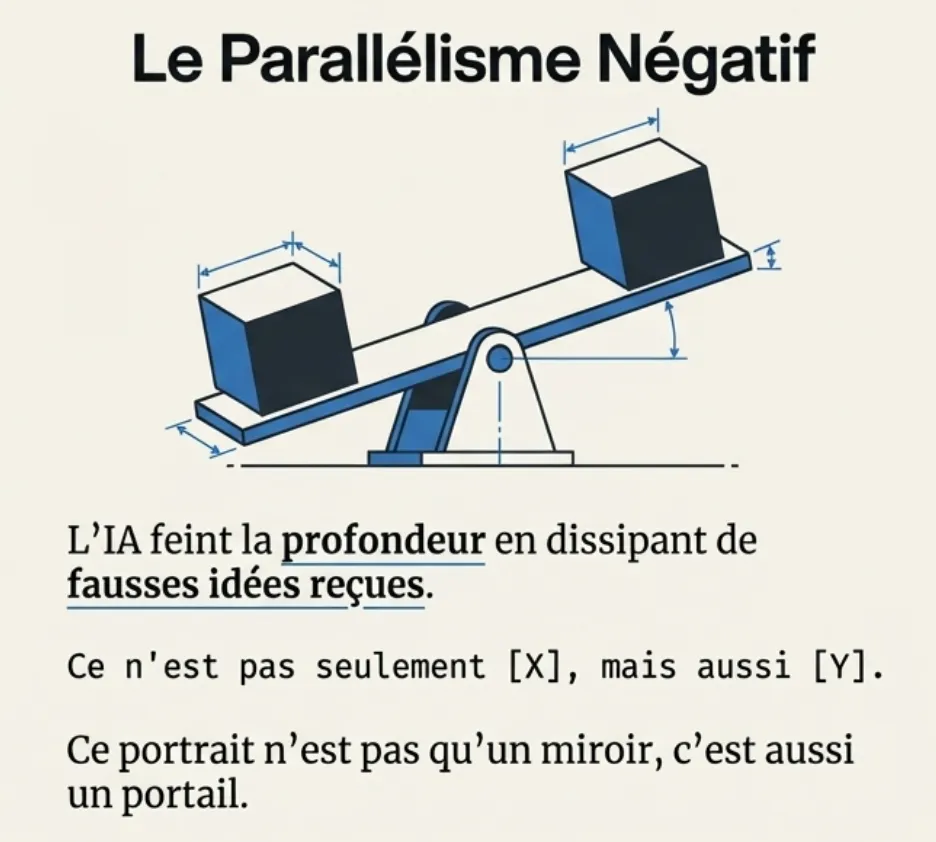
The structure is seductive. It gives the impression of a thought that cuts to the chase, that goes to the heart of the matter. Except that it often says nothing. It dresses up a banality as depth.
Wikipedia catalogued it as one of the most frequent and most difficult signs to detect, precisely because it imitates reasoning without being any.
What to do instead: state directly. “Culture blocks adoption, not the tool.” No staging. Just the thesis.
2. The list instead of the thought
When AI does not know how to connect ideas, it piles them up. Three points. A term in bold. Its definition repeated in the next sentence.
The result looks like a PowerPoint presentation turned into text. Each idea is isolated, correctly labelled, and completely disconnected from the next.
The problem is not the list itself. It is that it replaces reasoning instead of supporting it. A text that thinks uses lists to recap. A text that does not think uses them to exist.
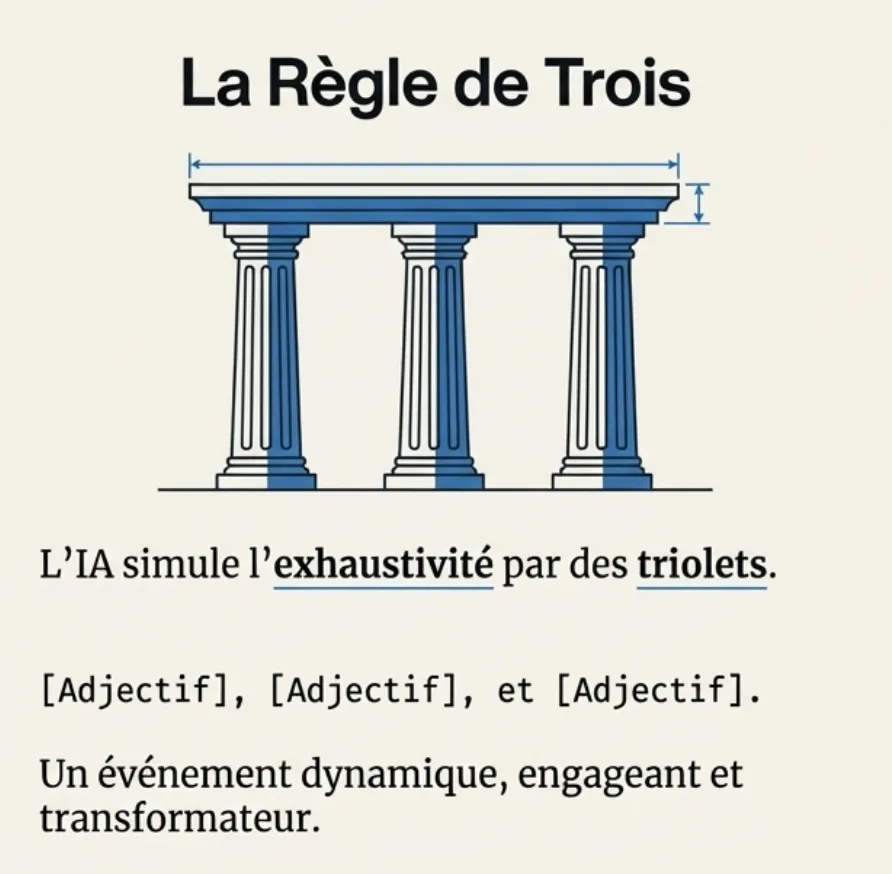
A related sign, less visible but equally telling: the rule of three. AI stacks three elements compulsively. Three adjectives. Three examples. Three benefits. “A creative, structured and results-oriented approach.” Never two. Never four. Always three.
If you reread your generated texts and every list has exactly three points, that is not rigour. It is a model reflex.
What to do instead: write the transition. Explain why one idea calls for the next. That is visible thinking.
3. The catch-all word
Crucial. Pivotal. Landscape. Lever. Unmissable. These words occupy space without carrying anything. They signal importance without demonstrating it.
Wikipedia’s editors note that LLMs resort to them compulsively, particularly when writing about subjects they cannot illustrate concretely. The catch-all word is a cover-up: it fills a gap where a precise example should have been.
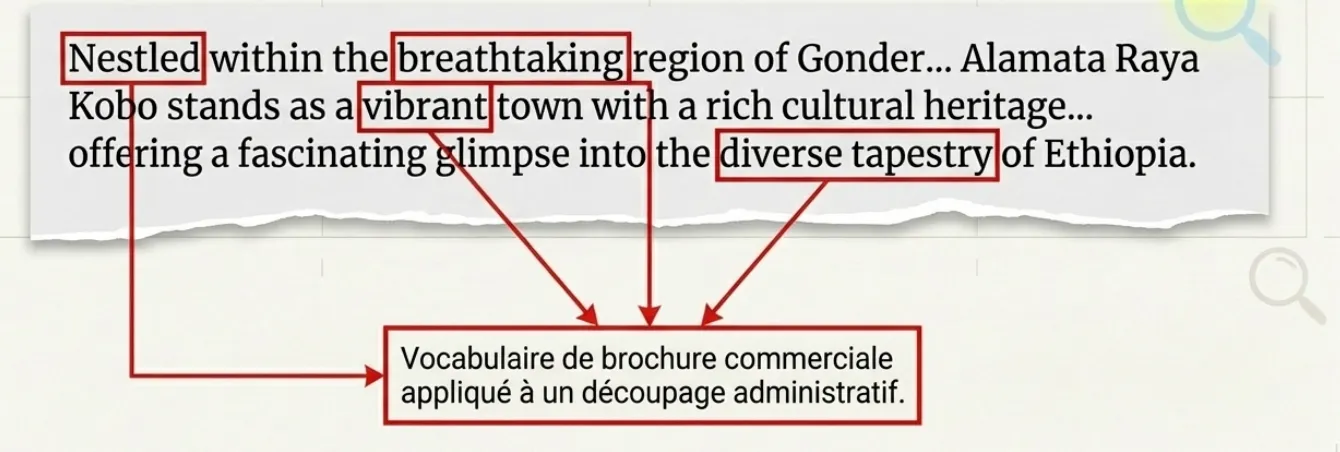
What to do instead: replace the qualifier with the proof. Not “a crucial issue,” but “if you do not do this before June, you lose the contract.”
4. The absence of experience
This is the hardest sign to correct, because it cannot be seen. It can be felt.
AI generalises because it has never lived anything. It cannot write: “this client looked embarrassed when I said the word prompt.” It cannot write: “I grasped this limit on a Tuesday morning in the middle of a training session, and I had no good answer.”
These details are proof that someone truly thought about what they wrote. Without them, the text may be accurate, useful, well-constructed. But it resembles no one.
What to do instead: add one personal observation per important section. One is enough. It grounds everything else.
5. Hollow grammatical construction
This is the most technical sign on the list. And the least well known.
AI avoids the verb “to be.” Not for elegance. Out of habit. It systematically replaces “it is a good method” with “this approach represents a lever of transformation.” It replaces “he led the team” with “he acted as primary coordinator.”
The result sounds more serious. But it says less.
Wikipedia catalogued it under two distinct forms. First, copula avoidance: “represents,” “constitutes,” “acts as,” “fits within.” Then closing gerunds: those sentence endings that add movement without adding meaning. “Underscoring the scope of the initiative.” Delete them. The sentence before stands on its own.
What to do instead: use the verb “to be” when it is right. “It is an effective method.” “He led the team.”
You are not deceiving your reader. You are deceiving yourself.
Most conversations about AI writing revolve around the same fear: being found out. A reader sensing it is not really you. Someone running your text through a detector.
That is the wrong question.
First, because detection tools are unreliable. Second, because your readers, in their vast majority, are not trying to catch you out. They are trying to read something useful, clear, that resonates with them or helps them.
The real problem is elsewhere.
By delegating formulation to AI, you lose something important: the habit of searching for your own words. Of pausing on an idea until you find the right way to say it. Of producing a sentence that could only have come from you, because it carries your experience or your way of seeing things.
That habit grows dull. Without you noticing.
And one day, you find yourself unable to write two paragraphs without opening a chat window.
AI can be a useful tool for working on a text. But it cannot think for you. It can only imitate thought with what you give it. If you give it little, it fills the gaps with its own reflexes. And its reflexes, you now know them.
The right question is therefore not “does it show?”, but “is it still me?”
Resource of the week: Paul Graham and writing in the AI era
Paul Graham is one of the most widely read essayists in the tech world. Founder of Y Combinator, he has been publishing short texts on thinking, work and writing since 2001. He publishes when he has something to say.
What few people realise: he has been writing about writing for twenty years. And what he said before ChatGPT remains more relevant than ever.
Five essays deserve your attention:
- Writes and Write-Nots (October 2024). The most direct essay on AI and writing. Graham argues that delegating writing is delegating thinking. His conclusion: writing will become an active choice, like doing sport.
- Putting Ideas into Words (February 2022). Writing does not serve to transmit already-formed ideas. It forms them. About half of final ideas are born during the writing itself.
- Good Writing (May 2025). Style and substance are linked: improving the rhythm of a text forces you to correct the thinking. This connection disappears when you accept a model’s structure.
- The Age of the Essay (September 2004). A real text is not a thesis to defend. It is an attempt. AI does not do that. It starts with a structure and fills it in. That is the opposite.
- Writing, Briefly (March 2005). 80% of ideas arrive after you start writing. Draft a bad first version, fast. Rewrite relentlessly. Read aloud to spot what sounds wrong.
All five essays are short and available for free at paulgraham.com.
The tool to test: Wispr Flow
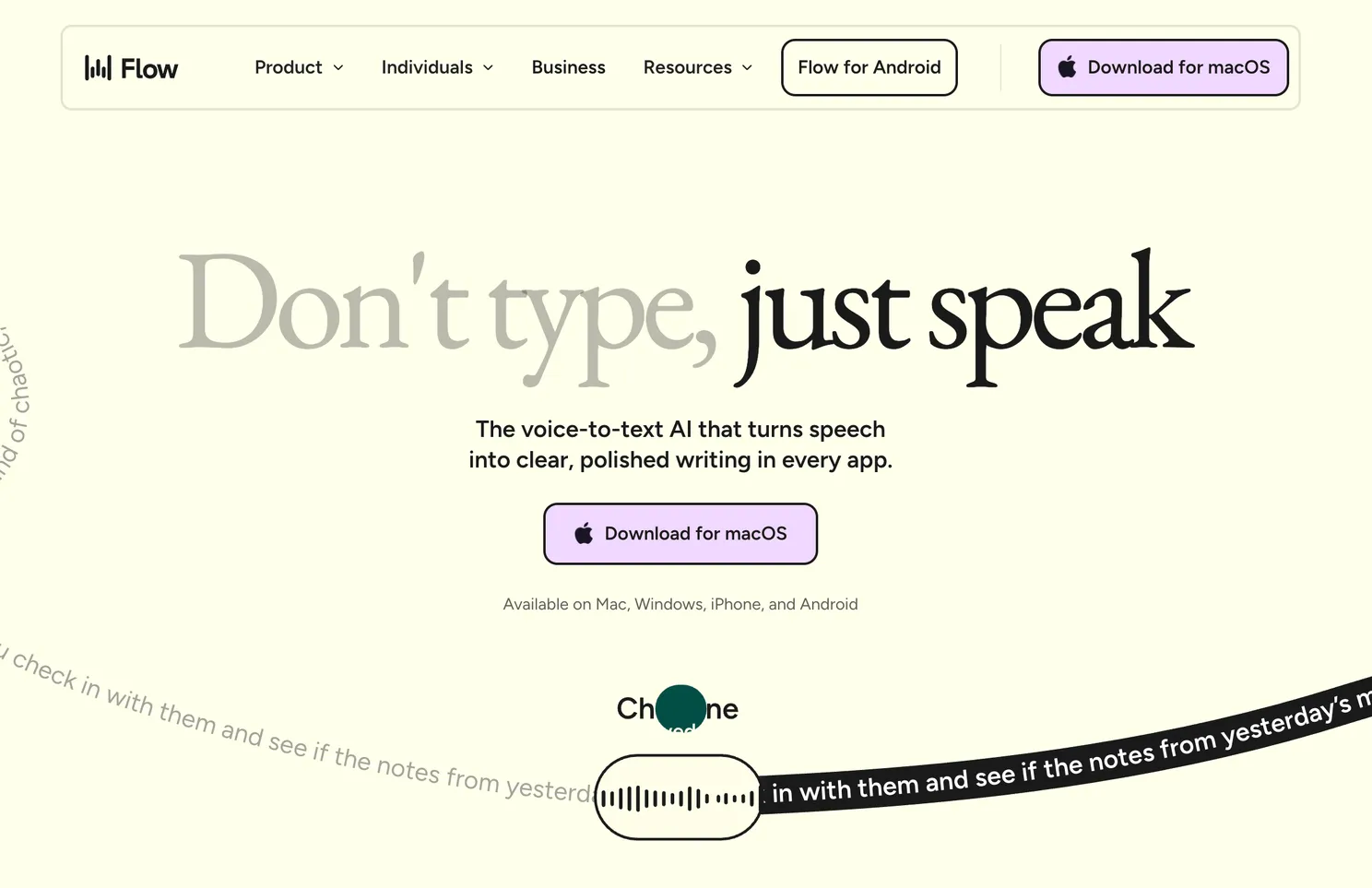
There is one thing AI does not really know how to do for you: speak like you.
I am not referring to “style” in the literary sense. I mean your actual voice. The one you hear when you explain a file to a colleague, when you summarise a meeting while walking to the next one.
Out loud, you do not say “in a rapidly changing landscape.” You say what you think, with your words, your rhythm, your shortcuts.
That material, AI cannot guess. But you can give it to them.
The method: dictate first, write after. Before opening an AI tool, take two minutes to say what you genuinely want to express. Dictate as you would speak to someone. Then, and only then, give this transcription to AI with a simple instruction: “reformulate without changing the substance, without adding emphasis, keeping a direct tone.”
The difference is immediate. Not because AI suddenly becomes more accurate. Because it is finally working from living material. Yours.
Wispr Flow is one of the most convincing tools I have tested for dictating in French, available on iOS, Android and Mac. It corrects filler sounds, formats intelligently and integrates everywhere.
Wikipedia wanted to detect impostors. They ended up mapping something more interesting: the way a technology thinks for you when you do not resist it.
Your voice is not recovered by deleting words. It is recovered by picking up the habit of thinking before writing.
Dictate. Reformulate. Add what only you can add. And reread with one question in mind.
Is it still me?
