
Artificial intelligence is everywhere, from search engines to creative tools and strategic business decisions.
If you do not take the time to understand AI, you risk being subject to it without ever grasping what is at stake.
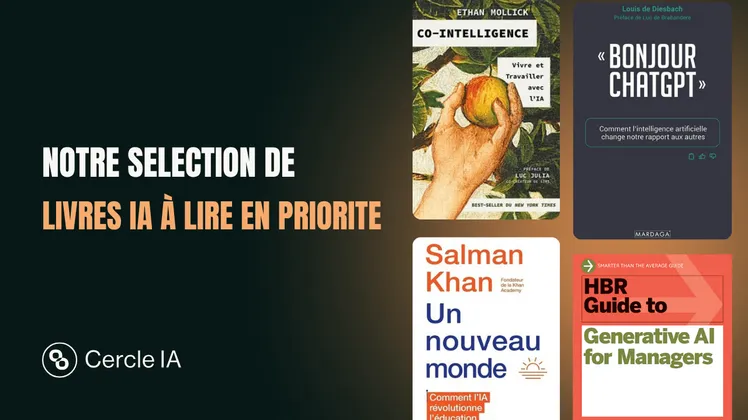
This article offers a selection of essential books to better understand AI, its promises as well as its risks, and how to use it concretely.
In this article, you will discover:
- Accessible books, chosen for their clarity and impact
- Varied perspectives: technical, philosophical, geopolitical, and even literary
- Reading keys for understanding AI without unnecessary jargon
Why you should read books about AI now
Every week, a new announcement about artificial intelligence seems to change everything: a revolutionary tool, an ethical debate, a regulatory decision. The press gets carried away, social media erupts, opinions fly…
Reading a book on AI is an opportunity to step back. To leave the flow, structure your understanding, and identify the underlying trends behind the daily noise.
For decision-makers, consultants, independent professionals, or managers, this distance is essential for avoiding reactive decisions and instead choosing with awareness and confidence.
You do not need to become an engineer. But you need to be able to tell what matters: what will last, what will affect your profession, what constitutes real transformation (and not mere trend).
How these books were selected
Three criteria guided the selection:
Accessible but demanding These books do not require specific technical skills, but they call for active reading. They offer intellectual depth suited to those who need to think clearly in order to act wisely.
Complementary angles Each title sheds light on AI from a different angle: strategy, geopolitics, ethics, economics, fiction, or systems critique.
A balance between reflection and action These readings are not here to theorise endlessly, but to help professionals structure their ideas, adjust their stance, and inform well-considered decisions.
The AI books to read this summer
Co-intelligence: living and working with AI — Ethan Mollick
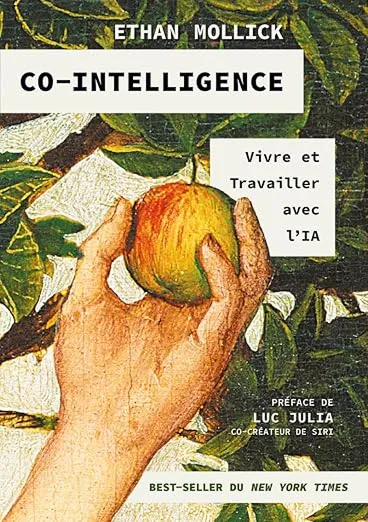
Co-intelligence: Living and working with AI by Ethan Mollick is a landmark work exploring the growing impact of artificial intelligence on our lives, our ways of working, and our creative capacities.
Published in April 2024, this book may seem “dated” but remains a classic whose lessons hold up against the rapid evolution of AI.
Ethan Mollick is a professor at Wharton and author of the highly popular One Useful Thing newsletter. In Co-intelligence, he proposes a clear-eyed and pragmatic approach to collaboration between humans and artificial intelligence — a “co-intelligence” that combines the strengths of both worlds.
A practical and strategic guide: Mollick shares concrete strategies for inviting AI to “the table”, evaluating its behaviour, understanding its strengths and weaknesses, and working with it in a complementary way.
He invites the reader to become a “centaur” (where human and AI combine their efforts) and then a “cyborg” (an even more integrated collaboration), highlighting that in the future, almost all jobs and processes will be transformed — but rarely fully replaced — by this new co-intelligence.
A new world — How AI is revolutionising the education of our children — Salman Khan
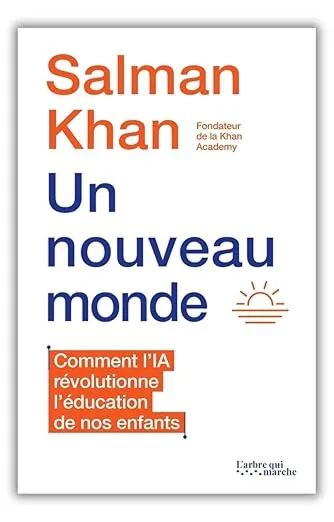
In A new world, Salman Khan, founder of Khan Academy, offers a manifesto for the school of the future, in which generative AI is a catalyst for transforming the education of children (and their parents).
For Salman Khan, generative AI brings three key benefits:
- Highly personalised learning
- Strengthening inclusion and equity
- Renewing the role of the teacher
HBR guide to generative AI for managers — Elisa Farri and Gabriele Rosani
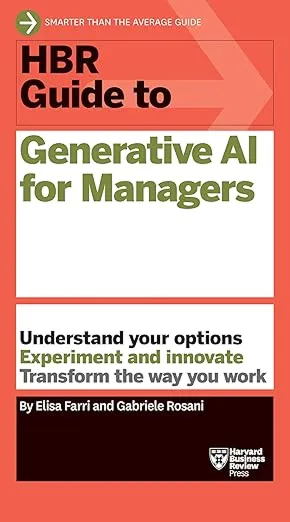
Published by Harvard Business Review Press in early 2025, this practical guide accompanies managers across all sectors in the concrete adoption of generative artificial intelligence to serve their performance, innovation, and leadership.
Why read this guide?
- Accelerate the uptake of AI: The book distils practical advice, case studies, ready-to-use prompts, and immediately applicable strategies.
- Cover all the key uses for managers: This manual presents 35 managerial tasks directly improvable through GenAI.
- Distinguish two usage logics: (i) Co-Pilot: delegate certain tasks or analyses to AI to save time; and (ii) Co-Thinker: engage with AI as a thinking partner.
The authors are recognised consulting professionals: Elisa Farri (Vice-President of the Management Lab at Capgemini Invent and member of the Thinkers50 Radar 2023) and Gabriele Rosani (Content and Research Director at the Management Lab of Capgemini Invent).
Hello ChatGPT: how artificial intelligence is changing our relationship with others — Louis de Diesbach
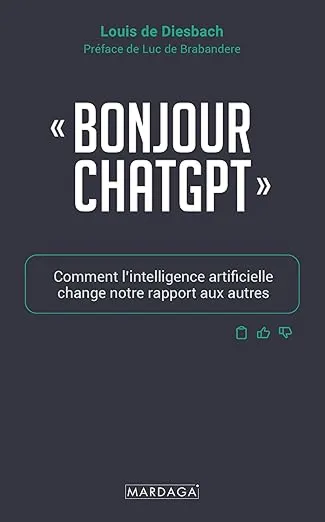
This work offers a reflection on the intrusion of artificial intelligence into our daily lives. Within a matter of weeks, ChatGPT established itself among more than one hundred million users, upending our relationship with new technologies and, by extension, with each other.
Louis de Diesbach is a consultant, essayist, and speaker on the subjects of artificial intelligence and the ethics of technology. Holding degrees in philosophy and social sciences, he brings a multidisciplinary approach — combining anthropology, history, psychology, ethics, and philosophy — to decode the upheaval caused by the mass arrival of generative AI.
Conclusion: read and act in the age of AI
AI is profoundly transforming our societies, our professions, and our frames of reference at an unprecedented pace.
In this context, taking the time to read books that explore the challenges of artificial intelligence is a way of refusing to be swept along by the ambient noise, and instead discerning the real dynamics at work.
Key takeaways:
- These books help you rise above the daily media flow.
- They offer a diversity of viewpoints, from the most pragmatic to the most philosophical.
- Each one provides concrete levers for thinking, acting, and deciding more wisely in the face of AI.
You do not need to read everything. But starting with one or two of these titles may be enough to transform the way you approach AI.
