

Welcome to edition #05 of the Cercle IA newsletter.
For Noam Chomsky, linguist and philosopher, AI is a “lumbering statistical engine for pattern matching,” a trivial technology whose superficiality threatens to degrade science and debase ethics.
Henry Kissinger, strategist and statesman, saw exactly the opposite: he presented AI as a revolution comparable to the printing press, a technology that changes the way societies produce knowledge, transforming politics and society as a whole.
Two of the most influential intellectual figures of the 20th century. The same technology before their eyes. Two radically opposed perceptions.
How can two minds as brilliant as theirs arrive at such radically different conclusions when observing the same phenomenon?
To answer this question, I draw on ideas developed by Richard Susskind in his book “How To Think About AI”. A professor at Oxford, Susskind is a world-renowned British expert on the future of legal services and the impact of technology.
In this edition:
- Process-thinkers vs. outcome-thinkers: the intellectual divide that explains why experts cannot agree on AI
- The AI fallacy: why waiting for AI to “think like us” makes you miss its potential
- The decision matrix: when to prioritise process understanding, when to focus on outcomes
- Resource: the Perplexity at Work Guide and how to restructure your day with AI
- The tool: compar:IA, to develop your critical judgement on different AI models
Process-thinkers vs. outcome-thinkers
In his book, Susskind draws on C.P. Snow’s famous “two cultures” divide to identify an analogous split in the world of AI.
Noam Chomsky and the “process-thinkers” camp
“Process-thinkers” are primarily interested in the how: how do AI systems work, how does the human mind reason?
Noam Chomsky represents the archetype of this mode of thinking. In March 2023, he claimed it was “both comical and tragic” that so much attention was being paid to something so insignificant, fearing that AI would only “degrade our science and debase our ethics.”
Kissinger and the “outcome-thinkers” camp
On the other side, “outcome-thinkers” focus on the consequences of AI. For them, the technical details of a system’s internal workings are secondary compared to what it produces.
Henry Kissinger perfectly embodies this perspective. He argues that “what these systems do is of paramount importance, rather than how they do it.”
Which camp are you in?
If you are naturally a process-thinker:
- You first ask: “How does AI arrive at this result?”
- You are sceptical until you understand the mechanism
- Risk: paralysis by analysis, missed opportunities while you try to understand everything
If you are naturally an outcome-thinker:
- You first ask: “Is this result useful?”
- You experiment quickly and adjust based on results
- Risk: blind spots on limitations, costly mistakes from lacking understanding of actual capabilities
How to avoid the “AI fallacy” and find balance
For Susskind, this is where the AI fallacy strikes — the mistaken assumption that the only way to get machines to perform at the level of the best humans is to somehow replicate the way humans work.
Consider self-driving cars. Nobody seriously suggests that the optimal way forward is to develop robots that sit in the driver’s seat imitating the way human beings drive.
The mistake is to fail to recognise that AI systems do not need to imitate or reproduce human reasoning. Thinking otherwise is to adopt a far too anthropocentric vision of AI.
Decision matrix: when to prioritise process understanding, when to focus on outcomes
To know which mode to prioritise, ask yourself these 3 questions:
1. Risk level: “What is the cost of an error?”
- Low stakes → Prioritise outcome-thinking
- Serious consequences (client advice, sensitive analysis, legal document) → Prioritise process-thinking
2. Mastery: “Am I able to verify what AI gives me?”
- You know the field well → Prioritise outcome-thinking
- You are in unfamiliar territory → Prioritise process-thinking
3. Recurrence: “Will I do this task often?”
- One-off task → Prioritise outcome-thinking
- Recurring task → Prioritise process-thinking
Resource of the week: the Perplexity at Work Guide
This guide offers a structured approach to using artificial intelligence to work smarter, presenting AI as a natural extension of three essential steps:
- Block distractions: AI first helps you reclaim your time and focus by delegating repetitive tasks.
- Multiply your capabilities: AI becomes a force multiplier for conducting research, synthesising information and producing deliverables.
- Get results: channel this increased capacity towards specific, measurable outcomes.
Tool of the week: compar:IA
compar:IA is a free tool developed by the French Ministry of Culture and the Interministerial Digital Directorate (DINUM) and launched in October 2024.
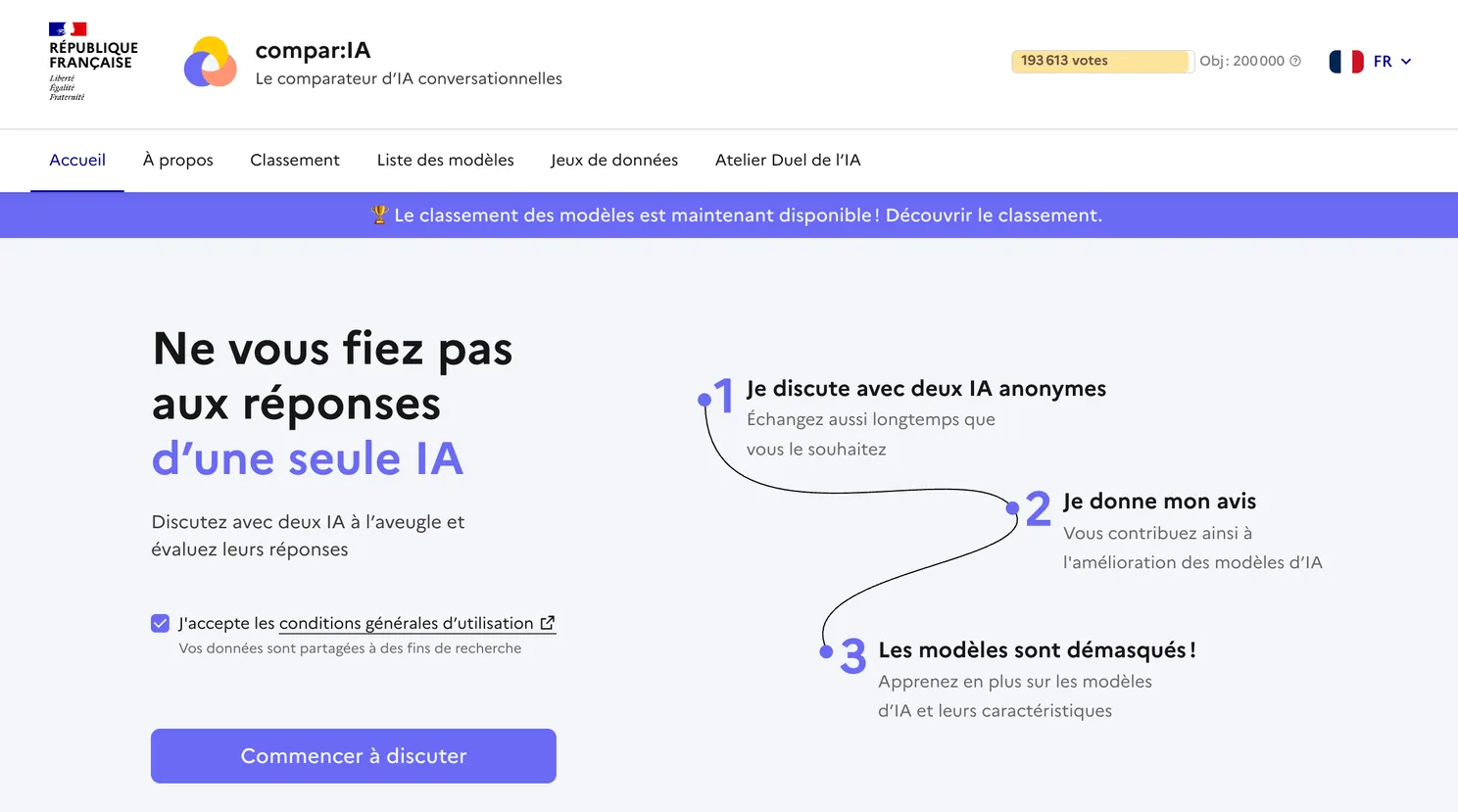
compar:IA allows you to anonymously compare the responses of several conversational AI models, particularly for use in the French language.
Main features:
- Simultaneous querying of two generative AI models anonymously
- Evaluation of relevance, clarity, coherence and absence of cultural bias
- Revelation of model identities with their environmental footprint
- Comparison of 18 to 23 different models (GPT-4o, Gemini 1.5 Pro, French or Asian models…)
compar:IA is a remarkable tool that embodies a strong vision of public service in the AI space: it promotes neutrality and protects users from commercial pressure.
P.S.: This newsletter may contain affiliate links. Your purchases via these links support this editorial work at no extra cost to you.
