
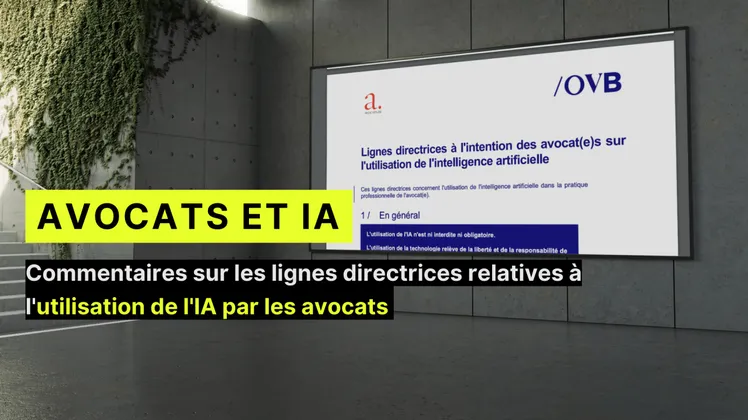
The guidelines on the use of artificial intelligence by lawyers, published by Avocats.be and the OVB on 31 January 2025, represent an important step forward in framing the use of these technologies.
Here is our analysis and our recommendations for deepening this framework.
The strengths of the guidelines
A search for balance
The guidelines strike a balance between innovation and the ethical framework, giving lawyers the freedom to explore AI while reminding them of their fundamental responsibilities.
Key strengths:
- Awareness of the risks of AI models, in particular LLMs
- Strengthened protection of professional secrecy
- Harmonisation of practices across Belgian bars
- A pragmatic approach that encourages responsible innovation
7 recommendations for deepening the AI guidelines for lawyers
1. Refine the distinction between AI tools
Issue: Not all AI systems are equal in terms of security and functionality.
Solution: Create a clear classification distinguishing:
- Generic tools (ChatGPT, Claude, Perplexity…)
- Specialised legal solutions
- Autonomous AI agents
- RAG (Retrieval-Augmented Generation) tools
2. Clarify security conditions
Issue: The notion of a “closed environment with adequate safeguards” remains vague.
Solution: Establish minimum standards for:
- Local vs cloud hosting
- Data encryption
- Access traceability
- Contractual guarantees
3. Propose evaluation criteria
Issue: Lawyers lack benchmarks for choosing their tools.
Solution: Develop an evaluation framework covering:
- Security level
- Reliability of outputs
- GDPR compliance
- Costs and pricing models
4. Validation methodology
Issue: How can the quality of AI-generated outputs be assured?
Solution: Establish a validation protocol including:
- Systematic double-checking
- Verification of cited sources
- Process traceability
- Documentation of decisions
5. Rethinking billing
Issue: AI is fundamentally transforming the economics of legal services.
Solution: Anticipate the shift towards:
- Value-based billing
- Categorisation of services (human/assisted/automated)
- Transparency about AI use
6. Mandatory continuing education
Issue: The rapid evolution of AI requires constant skills updates.
Solution: Put in place:
- An AI training programme tailored to lawyers
- Certifications by legal speciality
- Organised technology monitoring
- Sharing of best practices
7. Encourage innovation
Issue: Moving beyond a defensive stance to harness the potential of AI.
Solution: Promote:
- Framed experimentation
- Sector-specific case studies
- Support for law firms
- Measurement of productivity gains
Essential definitions to clarify
Missing technical concepts
- AI agents: Autonomous systems capable of executing complex tasks
- RAG: A technique for enriching responses using external databases
- Fine-tuning: Adapting models to specific legal corpora
Legal notions to clarify
- “Adequate safeguards”: Precise technical and contractual criteria
- Specific consent: Modalities for obtaining it in an AI context
- Differential liability: The applicable regime versus traditional sources
Specific issues identified
Data protection
Challenge: Reconciling the utility of AI with the preservation of professional secrecy.
Approach: Favour on-premise or sovereign cloud solutions, and develop purchasing consortia to negotiate tailored terms.
Risk management
Challenge: Pseudonymisation does not protect against all exposure risks.
Approach: Secure the entire processing chain, from transcription to final analysis.
Evolution of the profession
Challenge: AI is fundamentally transforming certain legal practices.
Approach: Support the transition towards new models of value creation.
Conclusion: a first step towards informed adoption
The guidelines form a solid foundation that now needs to be developed further.
The question is no longer whether AI will transform the legal profession, but how to accompany this transformation in an ethical and effective manner.
Recommended next steps:
- Immediate training of practitioners on the challenges and opportunities of AI
- Framed experimentation with secure tools
- Experience sharing among practitioners and firms
- Regular updating of recommendations in response to technological developments
Artificial intelligence represents a historic opportunity to improve the efficiency and accessibility of legal services.
Discover the Cercle IA training programme specifically designed for professionals in advisory roles.
