
The adoption of artificial intelligence in the legal sector has reached a decisive turning point: for lawyers as for their clients, the question is no longer whether to use it, but how to integrate it well.
The figures speak for themselves: internationally, the share of legal professionals using AI rose from 19% in 2023 to 79% in 2024 (sources: Legal.io, 2024 — LawNext, 2024). In France, as early as 2023, nearly one lawyer in two had already integrated or was about to integrate AI into their daily practice (source: LexisNexis).
This transformation is not coming from law firms alone: clients are following suit. In 2024, 70% of legal services clients said they were favourable or neutral towards their legal counsel using AI (sources: Legal.io, 2024 — LawNext, 2024).
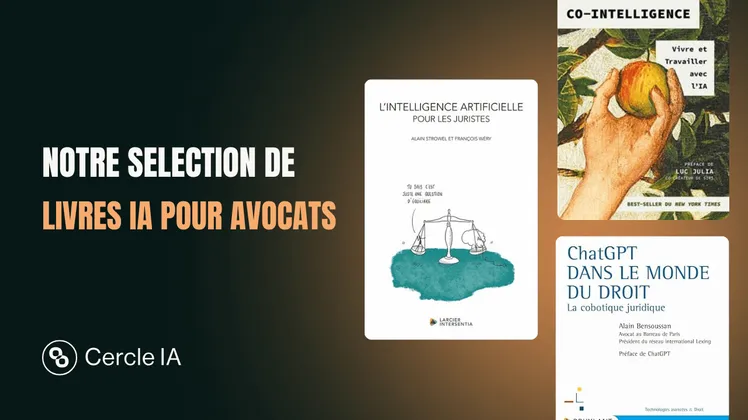
Faced with these challenges, reading reference works is essential to stay current. To guide you in this process, this article offers a selection of three complementary works, chosen for their practical approach and their direct relevance to legal professionals.
Our selection combines general AI books and specialist legal manuals on the use of generative AI in legal practice.
Co-intelligence: living and working with AI (Ethan Mollick — First Editions, 2024)

Why start with this book? Because before mastering legal AI techniques and tools, you need to understand the fundamental principles of collaborating with AI.
Published in April 2024, Co-intelligence: Living and working with AI has established itself as an essential reference on the professional integration of artificial intelligence. Its author, Ethan Mollick, is a professor at the prestigious Wharton School and author of the One Useful Thing newsletter, followed by thousands of professionals.
- Ideal for: Practitioners who are new to AI and are looking for a proven methodology
- Less suited for: Those who want immediately specialised legal applications
- Key takeaway: A solid conceptual foundation for approaching more technical works
The book develops the concept of “co-intelligence”, defining a new paradigm of collaboration between human expertise and the capabilities of generative AI. Throughout Co-Intelligence, Mollick presents AI as a powerful tool for amplifying — never replacing — the work of lawyers, legal professionals, and judges.
Mollick’s four fundamental principles
- Always invite AI to the table: Use AI intensively across various tasks to understand its “jagged frontier” — its capabilities are not uniform.
- Always keep the human in the loop: Even as AI becomes increasingly capable, humans must remain active participants in the process.
- Treat AI like a person (but specify what kind of person): Engage with AI as if it were human, by defining specific roles or personas to optimise its performance.
- Assume that the AI you have today is the worst you will ever use: Stay open to new developments and adapt as AI progresses.
Why we recommend this book to lawyers and legal professionals
- Legal drafting and decision support: Mollick describes how generative AI assists lawyers by providing immediate feedback, analysing large datasets, and broadening perspectives in legal drafting.
- Practical legal examples: The book references real legal scenarios, such as a judge using Claude.ai to help draft court orders.
- Scaling legal expertise: Mollick notes that there is more legal work than there are available lawyers worldwide — AI can help bridge this access-to-justice gap.
- Ethical and regulatory considerations: The book addresses the importance of complying with disclosure rules around AI use.
Limitations to keep in mind: The work remains generalist and does not address the specific ethical requirements of French or Belgian law. The author takes a resolutely techno-optimistic stance that may be worth balancing with other viewpoints.
Artificial intelligence for legal professionals (Alain Strowel & François Wery — Larcier, 2025)
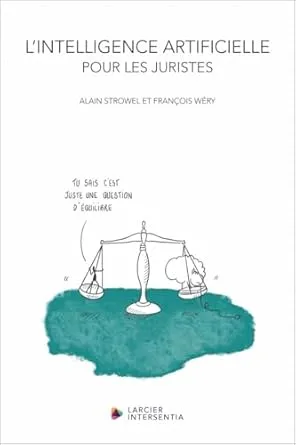
The reference manual on law and AI. Where Mollick lays the conceptual groundwork, Strowel and Wery provide a didactic and thorough presentation of the theoretical framework, as well as a genuine “AI toolkit” for legal professionals.
- Ideal for: Practitioners ready to invest time to concretely master legal AI
- Less suited for: Those looking for a general and strategic approach to AI
- Ideal complement: Read after Mollick to move from the right mindset to building a solid theoretical and practical grounding
The authors are two renowned experts:
- Alain Strowel: Barrister at the Brussels Bar since 1988, senior partner at Pierstone, professor at Université Saint-Louis–Bruxelles and UCLouvain.
- François Wery: Lawyer specialising in intellectual property, physicist, European patent attorney, lecturer at UCLouvain.
Structure of the work
Part I — What is generative AI?
- The tools and players of generative AI
- Concepts and how AI works
- Strengths and limitations of generative AI
Part II — How to put AI at the service of legal professionals?
- The FRITES® model for composing prompts adapted to law
- The 9C™ model for conversing with AI
- Guides for drafting, analysing, brainstorming, and researching with AI
- Ethical and confidentiality aspects
- Personal data protection and GDPR compliance
Part III — What are the challenges posed by AI?
- Major societal challenges (environment and employment)
- The risk of disinformation
- Protection of creators and intellectual property
- European AI regulation
ChatGPT in the legal world: legal cobotics (Alain Bensoussan — Bruylant, 2024)
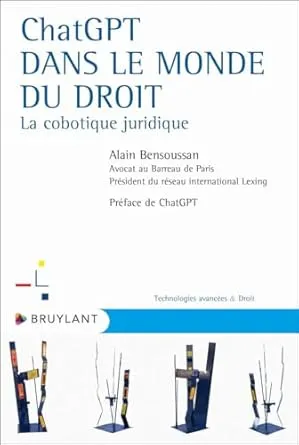
The first French-language work dedicated specifically to the use of ChatGPT by legal professionals. The book highlights the concept of “legal cobotics”, an innovative approach where artificial intelligence acts as a co-pilot for legal professionals.
- Ideal for: Practitioners seeking to make the most of ChatGPT while respecting ethical and regulatory dimensions
- Less suited for: Those looking for a multi-tool approach to AI
Why we recommend this book to lawyers and legal professionals
- Pioneer of “legal cobotics”: Bensoussan proposes a vision where AI is not a replacement, but an essential collaborator that assists with complex tasks.
- Concrete and strategic applications: The work details how ChatGPT can be used for contract drafting, case law research, legal document analysis, and preparing submissions.
- Ethical and professional responsibility issues: The book addresses critical questions around data confidentiality, professional secrecy, and the user’s liability in the event of errors.
- A forward-looking perspective: Beyond immediate uses, Bensoussan projects the evolution of AI in law.
Why lawyers must read about AI now
Reading a book on AI is an opportunity for strategic reflection. It is a chance to step back from the media noise, structure one’s thinking, understand the underlying mechanisms, and identify the real implications for your practice.
For a lawyer, this broader perspective is vital. The goal is not to become a coding expert, but to master the concepts needed to distinguish the relevant tool from the accessory, and lasting transformation from mere trend.
How these books were selected
Three criteria guided the selection of these works:
- Relevance to legal practice: Each one speaks directly to legal professionals, using appropriate terminology and developing concrete issues.
- Complementary and essential angles: Each work sheds light on questions related to the use of AI in law from a different angle.
- A balance between strategic thinking and action: These readings allow lawyers to adjust their stance, equip their practice, and inform sound decisions.
You do not need to read all of these books at once. But each one deserves a place in your library and within easy reach of practitioners who can refer to them for daily guidance.
This article may contain affiliate links to tools that have been personally tested and approved. Purchases made through these links support our editorial work at no extra cost to you.
